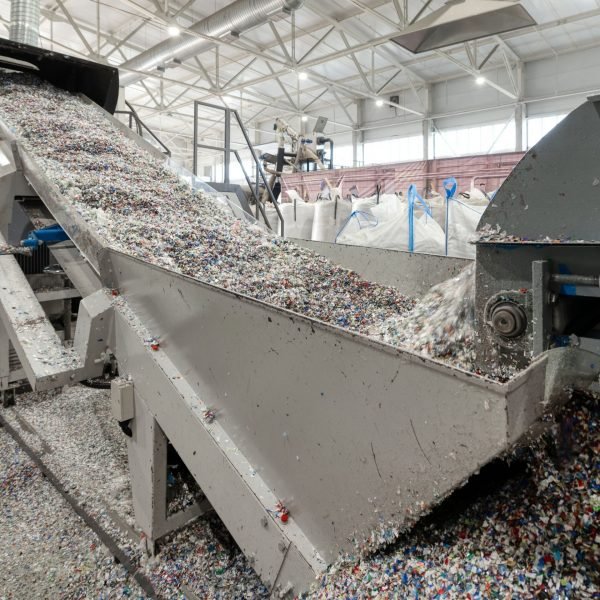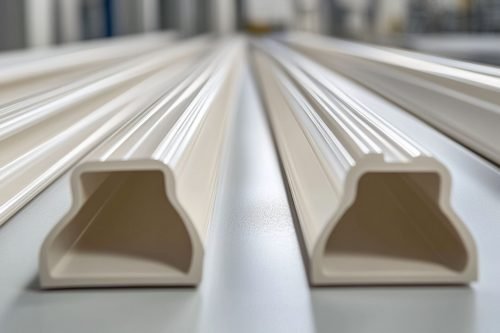
Injection Moulding Technology, Basics of the Most Common Processing Technique

What is injection moulding?
Injection moulding is the most widespread manufacturing process in the plastics industry. Thermoplastic granulate is melted, injected into a closed mould under high pressure and removed as a finished part once it has cooled. The process is capable of producing complex geometries in very short cycle times and in consistent quality, from micro components weighing only a few grams up to large parts of several kilograms.
The strength of the technique lies in its economy at high volumes. Once a mould has been built, identical parts can be reproduced millions of times, with tight tolerances and without rework.
The three components of an injection moulding machine
An injection moulding machine consists of three main components that work in sequence. Each component has a clearly defined role in the process.
Injection unit (plasticising unit)
The injection unit takes the granulate from the hopper, melts it inside a heated barrel using a rotating screw and pushes the melt into the mould under high pressure. This is where injection pressure, injection speed and melt temperature are set, the key control parameters of every injection moulding process.
Clamping unit
The clamping unit holds both mould halves together during injection. It has to withstand the internal melt pressure, which can reach several hundred to over a thousand bar. After cooling, it opens the mould and releases the finished part.
Mould (tool)
The mould defines the geometry of the part. It usually consists of two or more steel halves containing cavities, runners, cooling channels and ejectors. The mould is the most expensive single component and is purpose-built for a specific product family.
The five process steps at a glance
An injection moulding cycle runs through five clearly separated phases. In series production this cycle repeats every few seconds.
1. Material preparation
Granulate is loaded into the hopper and enters the heated barrel. The rotating screw conveys the material forward, where a combination of heater bands and friction heat melts and homogenises it. Moisture-sensitive materials are dried beforehand.
2. Injection
The screw moves forward and pushes the prepared melt through the nozzle into the closed mould under high pressure. The cavity fills completely, then additional melt is fed in during the holding phase to compensate for volume shrinkage.
3. Cooling
Inside the mould, the part cools through integrated cooling channels and solidifies. The cooling phase often takes up the largest share of the cycle time, since the part must be dimensionally stable before it can be ejected.
4. Ejection
The clamping unit opens the mould and ejector pins push the finished part out of the cavity. In automated lines, handling units pick up the part and place it down, while the next cycle already begins with material preparation.
5. Post-processing
Depending on the part, the gate is separated, flash is removed, and the component may be printed, painted or assembled. Many parts, however, leave the machine ready for installation, a key advantage of injection moulding.
Typical materials in injection moulding
Thermoplastics dominate the process because they can be remelted and reshaped repeatedly. The overview below shows four of the most commonly processed plastics.
| Material | Properties | Typical applications |
|---|---|---|
| PP (polypropylene) | Lightweight, chemically resistant, good flow behaviour, food-safe | Packaging, containers, closures, automotive interior |
| ABS | Impact-resistant, dimensionally stable, good surface quality, easy to paint | Electronic housings, toys, visible automotive parts |
| PE (polyethylene) | Flexible, tough, low melting point, very cost-efficient | Bottles, films, small technical parts, packaging |
| PC (polycarbonate) | Transparent, high-strength, heat-resistant | Vision panels, medical technology, safety goggles, light covers |
Advantages of injection moulding
The process did not become an industry standard by accident. The following five points explain its strong market position.
| Advantage | Benefit in practice |
|---|---|
| High volumes | Short cycle times enable millions of identical parts at low unit cost. |
| Complex geometries | Undercuts, wall thickness variations and intricate detail can be moulded in a single shot. |
| High dimensional accuracy | Tight tolerances are reproducible, parts come out ready to assemble. |
| Material variety | Almost every thermoplastic and many bioplastics can be processed. |
| Automation-friendly | The process runs largely autonomously, ideal for round-the-clock production. |
Disadvantages and limits
For all its strengths, the process has clear weaknesses that need to be considered during planning.
| Disadvantage | Implication |
|---|---|
| High tooling cost | An injection mould is a five- to six-figure one-off investment, only high volumes amortise it. |
| Long lead time | Designing and building a mould takes weeks to months, late design changes are expensive. |
| Geometric constraints | Extreme wall thickness differences, large hollow volumes or undefined undercuts are only partly feasible. |
Typical applications
Injection moulding is present across virtually every industry. Four sectors dominate the volume.
Automotive
Bumpers, dashboards, vent grilles, connectors and countless brackets are produced by injection moulding. The process combines low weight with high dimensional stability, a key factor in modern vehicle manufacturing.
Medical technology
Syringes, pipette tips, inhaler housings and implant components are injection moulded in cleanroom environments. Reproducibility and sterilisability are essential here.
Electronics
Housings for smartphones, sensors, connectors and switches are predominantly made by injection moulding. Tight tolerances and electrical insulation are reliably achieved.
Packaging
Closures, cups, buckets, caps and functional packaging parts are injection moulded in extremely high volumes. This is where the low unit cost of the process shines brightest.
Conclusion, the path to sustainable injection moulding with comp I verde
Injection moulding is the key technology of the plastics industry and will remain so for the foreseeable future. The interesting question is not whether the process is used but what material runs through the machine. With comp I verde, a home-compostable, biocompatible compound is available that can be processed on existing injection moulding equipment without retooling. Anyone relying on injection moulding today can keep the process and at the same time significantly improve the ecological footprint of their products.
Talk to us if you want to qualify comp I verde for your injection moulding application. We provide technical data sheets, processing recommendations and support through the first production phase.