Plastic Extrusion, Basics of Continuous Profile and Film Production
What is plastic extrusion?
Plastic extrusion is one of the cornerstone processes in modern plastics manufacturing. It turns thermoplastic granulate into a continuous strand with a constant cross-section, which is then cooled and cut to length. The defining feature is uninterrupted production, ideal for profiles, films, pipes and tubing in high volumes.
Unlike cyclical processes such as injection moulding or thermoforming, extrusion runs continuously. Once the line is set up, it can operate stably for hours or days. That makes the technology especially attractive for large volumes with consistent geometry.
Components of an extrusion line
An extrusion line is a coordinated system of several components. Four of them shape the process most directly.
- Extruder: The heart of the line. Inside the heated barrel, the granulate is melted, homogenised and conveyed forward under pressure.
- Screw: It feeds the material, builds pressure and provides thermal and mechanical plastification. Geometry and rotation speed define throughput and melt quality.
- Die (tool): This is where the melt takes its final shape. The cross-section of the die determines the profile, film width or pipe diameter.
- Cooling unit: Right after the die, the soft strand is brought down to temperature in water baths, calibration tools or chilled rolls and becomes dimensionally stable.
The five process steps at a glance
Modern lines are highly automated, yet every extrusion process follows the same five-step logic.
- 1. Material preparation: The granulate is dosed, pre-dried if necessary and fed into the extruder through a hopper. Clean preparation is the basis for stable end products.
- 2. Melting and homogenising: Inside the barrel, the material is heated by band heaters and the friction of the screw. A homogeneous melt with defined viscosity forms.
- 3. Shaping at the die: The melt is forced through the die under pressure and takes on its cross-section. Profiles, films or pipes are created here.
- 4. Cooling and calibration: The hot strand runs through cooling systems and, where needed, calibration tools. Only now does the product reach its final dimensional accuracy.
- 5. Cutting, winding or finishing: At the end of the line, the product is cut to length, coiled or packed and prepared for shipping.
Typical materials for extrusion
The choice of polymer largely determines the properties of the end product. These five thermoplastics dominate industrial extrusion.
| Material | Properties | Typical application |
|---|---|---|
| PE (polyethylene) | Flexible, chemically resistant, easy to process | Films, pipes, packaging |
| PVC (polyvinyl chloride) | Rigid or flexible, weather resistant | Window profiles, cables, flooring |
| PP (polypropylene) | High stiffness, good thermal resistance | Films, technical profiles, containers |
| PS (polystyrene) | Transparent, dimensionally stable, easy to colour | Packaging, trays, insulation boards |
| PA (polyamide) | High mechanical strength, abrasion resistant | Tubing, technical pipes, fibres |
Advantages of plastic extrusion
Extrusion became the default for continuous products for good reasons.
| Advantage | Benefit |
|---|---|
| Continuous production | High output without cycle-time losses |
| Strong economics | Low unit cost on large batch sizes |
| Wide geometry range | Profiles, films, pipes and tubing from one technology |
| Material flexibility | Suitable for almost any common thermoplastic |
| Reproducible quality | Stable process parameters secure dimensional accuracy |
| Recyclate integration | Regrind blends well into the material stream |
Disadvantages and limits of the process
Like any technology, extrusion has clear limitations that need to be considered upfront.
| Disadvantage | Impact |
|---|---|
| Constant cross-section | Complex 3D geometries are not feasible |
| High tooling cost | Dies and calibration tools require significant investment |
| Energy demand | Heating and continuous operation drive energy cost |
| Material sensitivity | Raw-material variation affects the continuous strand directly |
Applications in practice
Extrusion is the foundation for many products you would not immediately associate with the technology.
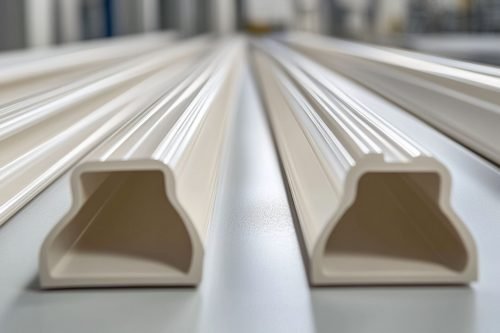
- Profiles: Window frames, gaskets and construction profiles come straight out of the continuous strand.
- Films: Packaging films, protective films and technical films are produced by cast or blown film extrusion.
- Pipes and tubing: Drinking water, waste water and industrial pipes are extruded profiles with high dimensional accuracy.
- Agricultural films: Mulch films, silage films and binding twine are extruded at scale, and biodegradable compounds are gaining ground here.
Conclusion, from standard film to biodegradable mulch film
Plastic extrusion is one of the most economical processes in plastics manufacturing and will remain the standard for continuous products for the foreseeable future. The interesting question is not whether to extrude, but what to extrude.
That is exactly where comp I verde fits in. The compound can be processed on existing extrusion lines and is particularly suited to applications where the film ends up in contact with soil or compost. For agricultural mulch films, this creates a double benefit: continuous production on proven equipment and a material that does not need to be collected after use.