Thermoforming, Basics for Sheet and Plate-Formed Plastic Parts
What is thermoforming?
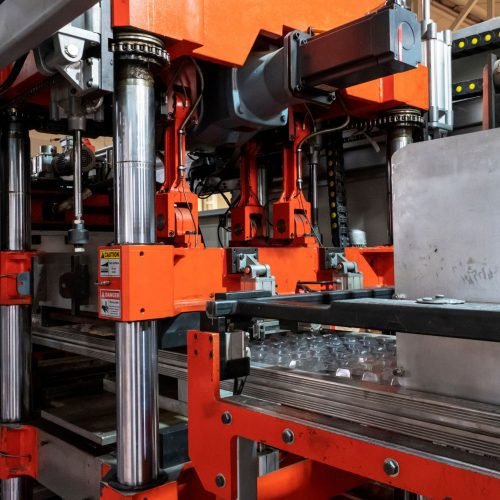
Thermoforming is a forming process in which a flat plastic semi-finished product is heated and then pulled onto a mould using vacuum or compressed air. A flat film or sheet becomes a three-dimensional part, from yoghurt cup inserts to technical interior components in vehicles.
The process is popular because it works with comparatively simple tooling, supports high output and is compatible with most common thermoplastics. Anyone developing packaging, deep-drawn parts or interior trims will sooner or later end up at the thermoforming line.
The five process steps at a glance
Whether film or plate is processed, every thermoforming cycle follows the same five steps. The parameters change, the sequence does not.
- 1. Preparation: The semi-finished product is cut to the right format and clamped into the frame. Clean material and proper clamping are the basis for consistent wall thickness.
- 2. Heating: Infrared emitters bring the plastic to its forming temperature, typically between 120 and 220 degrees Celsius depending on the material. Uniform heating is essential, otherwise wall thickness will vary across the part.
- 3. Vacuum or pressure forming: The softened semi-finished product is lowered onto the mould. Vacuum below the tool or compressed air from above forces the material against the contours and creates the desired geometry.
- 4. Cooling: The formed part cools in the tool until it drops below the softening point. Only then is the geometry dimensionally stable. Too short a cooling phase causes warping, too long unnecessarily extends the cycle.
- 5. Trimming: In the final step, the formed part is separated from the surrounding film or sheet. Punching tools, CNC routers or lasers are used depending on the application, and edge material is collected and fed back into the material loop.
Film and sheet thermoforming, the fundamental difference
In practice, thermoforming is divided by the thickness of the semi-finished product. This split is more than a technical detail, it decides on the type of equipment, the investment needed and the field of application.
Film thermoforming
Film thermoforming works with semi-finished products thinner than 1.5 millimetres. The film typically runs from a roll, is continuously heated, formed and punched. Typical applications are food trays, blister packs for consumer goods, yoghurt cups or medical trays.
Film thermoforming is designed for high cycle rates. A single line often produces tens of thousands of parts per shift, which keeps the per-part cost low.
Sheet thermoforming
Sheet thermoforming uses semi-finished products thicker than 1.5 millimetres, often well into the centimetre range. Individual sheets are loaded into the machine manually or by automation.
Typical applications include technical components, vehicle interior trims, housings, transport containers and large-format packaging. Volumes are lower, while part sizes and structural requirements are clearly higher.
Materials in thermoforming
Classical thermoplastics with a clear softening range are suitable for thermoforming. The following overview shows the materials most commonly used in practice.
| Material | Properties and typical use |
|---|---|
| PE, polyethylene | Tough, chemically resistant, low cost. Used for transport packaging, industrial liners and simple trays. |
| PP, polypropylene | Heat resistant up to around 100 degrees Celsius, food safe, dimensionally stable. Standard material for yoghurt cups, microwave trays and medical packaging. |
| PS, polystyrene | Rigid, easy to form, with a smooth surface. Used for single-use tableware, packaging trays and display parts. |
| PVC, polyvinyl chloride | Highly transparent, excellent deep-draw behaviour. A classic for blister packs, pharmaceutical packaging and clear visual parts. |
| PET, polyethylene terephthalate | Crystal clear, mechanically robust, recyclable. Standard for food trays, fruit packaging and convenience trays. |
Film and sheet thermoforming in comparison
Anyone deciding which variant fits a new product can rely on six simple criteria. They quickly indicate which direction the design should take.
| Criterion | Film thermoforming | Sheet thermoforming |
|---|---|---|
| Thickness | Below 1.5 mm | Above 1.5 mm, up to centimetre range |
| Application | Packaging, trays, blisters, cups | Technical parts, interior trims, housings, transport containers |
| Process | Continuous roll processing | Single sheet processing |
| Material usage | Low per part, thin walls | Higher per part, thick walls |
| Costs | Low per-part cost at high utilisation | Higher per-part cost, lower tooling cost |
| Volume | Very high series | Medium to small series |
Conclusion
Thermoforming is one of the most versatile forming processes in the plastics industry. The split into film and sheet thermoforming offers an economical solution for almost every application field, from thin-walled food packaging to large-format body panels.
Companies that want to move the process to sustainable materials can usually do so without buying new equipment. comp I verde can be extruded into films and sheets and processed on existing thermoforming lines. An established technology then becomes a concrete step towards compostable packaging and parts.