Blow Moulding Basics, Manufacturing Hollow Plastic Products
What is injection blow moulding?
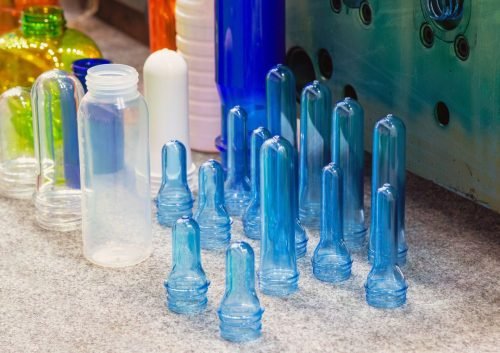
Injection blow moulding is a hybrid process that combines the precision of injection moulding with the shaping capability of blow moulding. In the first step, a precisely injected preform is produced. In the second step, this preform is expanded in a blow mould using compressed air, taking on the final hollow body geometry.
The process is well suited for small and medium sized hollow parts with tight dimensional tolerances, such as bottles, containers and technical components. Compared to classic extrusion blow moulding, injection blow moulding delivers cleaner necks, more uniform wall thickness and almost no material waste.
Components of the process
An injection blow moulding line consists of several coordinated assemblies. Each component plays a clearly defined role in the production cycle.
- Injection unit: Melts the plastic granulate and injects it around a core rod to form the preform.
- Core rod: Carries the preform through each station and defines the inner contour as well as the future bottle neck.
- Blow mould: Two part tooling that defines the final outer geometry of the hollow product.
- Blow station: Injects compressed air into the conditioned preform and pushes the material against the mould wall.
- Control system: Synchronises temperature, pressure, cycle times and the motion of each station.
- Cooling and ejection unit: Ensures dimensionally stable solidification and clean release of the finished part.
Step by step through the process
The cycle follows a fixed sequence with clear transitions between stations. A typical setup uses three stations, one for injection, one for blowing and one for ejection.
- 1. Preform production: The molten polymer is injected around the core rod, forming a thick walled, test tube shaped preform.
- 2. Transfer: The core rod with the still warm preform is moved into the blow station and enclosed by the open blow mould.
- 3. Blowing: Compressed air is introduced through the core rod, the preform expands and conforms to the inner surface of the blow mould.
- 4. Cooling: The blow mould is temperature controlled, the material solidifies while maintaining its final contour and wall thickness.
- 5. Ejection: The blow mould opens, the core rod moves to the ejection station and the finished product is released with no neck trimming required.
Typical materials for injection blow moulding
Material choice depends on product requirements, sterilisation needs and mechanical load. The following thermoplastics are especially common in injection blow moulding.
| Material | Property |
|---|---|
| PE (Polyethylene) | Flexible and chemically resistant, well suited for packaging and soft feel containers. |
| PP (Polypropylene) | Higher temperature resistance and good stiffness, ideal for sterilisable medical containers. |
| PET (Polyethylene terephthalate) | Highly transparent with strong gas barrier, the standard for beverage bottles and food packaging. |
| PVC (Polyvinyl chloride) | Good dimensional stability and chemical resistance, used for containers with demanding contents. |
Advantages of injection blow moulding
Injection blow moulding stands out wherever precision, repeatability and material efficiency are essential.
| Advantage | Benefit |
|---|---|
| High dimensional accuracy | Tight tolerances especially in the neck area, ideal for standard closures. |
| Uniform wall thickness | Consistent mechanical properties across the entire surface of the product. |
| No material waste | No pinch off, no flash, no trimming, lower raw material consumption. |
| Clean neck geometry | Injection moulded threads with defined geometry and high visual quality. |
| High output volumes | Short cycle times and fully automated flow for large series production. |
Limitations of the process
Despite its strengths, injection blow moulding is not the right fit for every application. These points should be considered during product design.
| Limitation | Impact |
|---|---|
| High tooling cost | Two tool sets required, injection mould and blow mould, higher initial investment. |
| Limited product size | Most economical for small to medium hollow parts up to roughly 500 ml. |
| Geometric constraints | Complex shapes with handles or undercuts are difficult to realise. |
| Material restrictions | Not every polymer is suitable, the material must be both injectable and blowable. |
Typical applications
Injection blow moulding is well established wherever hollow products with high accuracy are produced at scale.
- Beverage and food bottles: PET bottles for water, juices and carbonated drinks.
- Medical containers: Pill bottles, sterilisable vials and diagnostic containers made of PP or PE.
- Cosmetic and personal care packaging: Jars, cream containers and small lotion bottles with precise threads.
- Automotive: Smaller tanks and reservoirs for operating fluids and auxiliary systems.
- Household and industrial products: Cleaning agent bottles, chemical containers and dosing bottles.
Conclusion
Injection blow moulding is a precise and material efficient process for hollow products that require tight tolerances and high quality neck geometry. It closes the gap between pure injection moulding and classic extrusion blow moulding, and it is the method of choice for beverage, pharmaceutical and cosmetic packaging in high volumes.
Companies looking to shift the process toward more sustainable materials should evaluate polymer processability early. Bio based and biodegradable compounds can be used in injection blow moulding depending on their formulation, as long as the melt and stretch behavior match the tooling. BIOAFFIN supports manufacturers in qualifying suitable materials and tuning process parameters for each specific product.